Bedrock Agent
This template demonstrates how to handle Amazon Bedrock Agent events using function-based actions.
Architecture
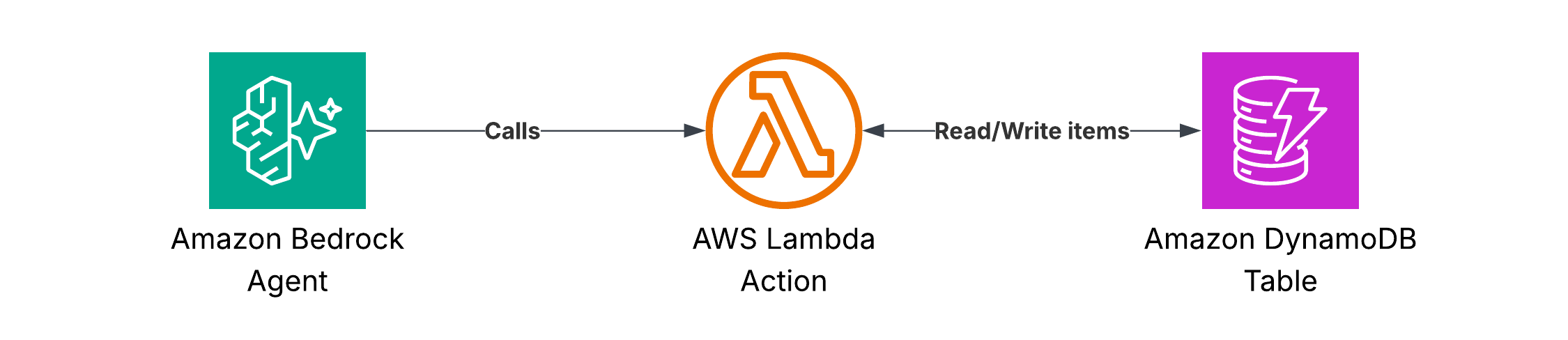
The template sets up:
- Amazon Bedrock Agent: Orchestrates user requests and identifies tool usage.
- AWS Lambda function: Resolves function calls using
BedrockAgentFunctionResolver. - Amazon DynamoDB table: Stores and retrieves items used by the agent.
Code
- Function code:
templates/agent - Unit tests:
tests/agent - Infra stack:
infra/stacks/agent.py
Deployment
Deploy the stack using:
mise run deploy agent
Features
- Function-based Actions: Uses the
@app.tool()decorator to expose functions to Bedrock Agents. - Automatic Parameter Mapping: Maps Bedrock Agent parameters directly to Python function arguments.
- Type Safety: Uses Pydantic models for data validation and camelCase alias conversion.
- Observability: Integrated with AWS Lambda Powertools for logging, tracing, and metrics.
Usage
Define Tools
Use the @app.tool() decorator to define tools that the agent can call:
@app.tool(name="getItem", description="Gets item details by ID")
def get_item(item_id: str) -> dict:
    return handler.get_item(item_id)
Item model
| Field | Type | Description | Required |
|---|---|---|---|
id |
UUID string | Unique item identifier (auto-generated, 1-50 chars) | No |
name |
string | Human-readable item name (1-100 chars) | Yes |
description |
string | Human-readable item description (max 500 chars) | No |
Environment variables
| Variable | Description | Required | Default |
|---|---|---|---|
TABLE_NAME |
DynamoDB table name | Yes | - |
SERVICE_NAME |
Powertools service name | No | bedrock-agent |
METRICS_NAMESPACE |
Powertools metrics namespace | No | BedrockAgent |
LOG_LEVEL |
Log level for the Lambda Logger | No | INFO |